Lucena
A chess training platform, built on one idea: what players lack is not analysis, it is the story of their own progress.
Try it
Opens on its own site.
Every platform now offers an engine evaluation: analysis has become free and unremarkable. What is still missing is the long story of a player getting better. Lucena starts from there.
The idea was first put to the test with a throwaway script: analyse about fifty games with Stockfish and see whether the recurring mistakes come out, accurate and actionable. Without that signal, the application was not worth building.
It all starts with the import: the application fetches games from Lichess, from Chess.com or from a PGN file, brings them to a common format, discards duplicates, and a nightly job only resynchronises what is new.
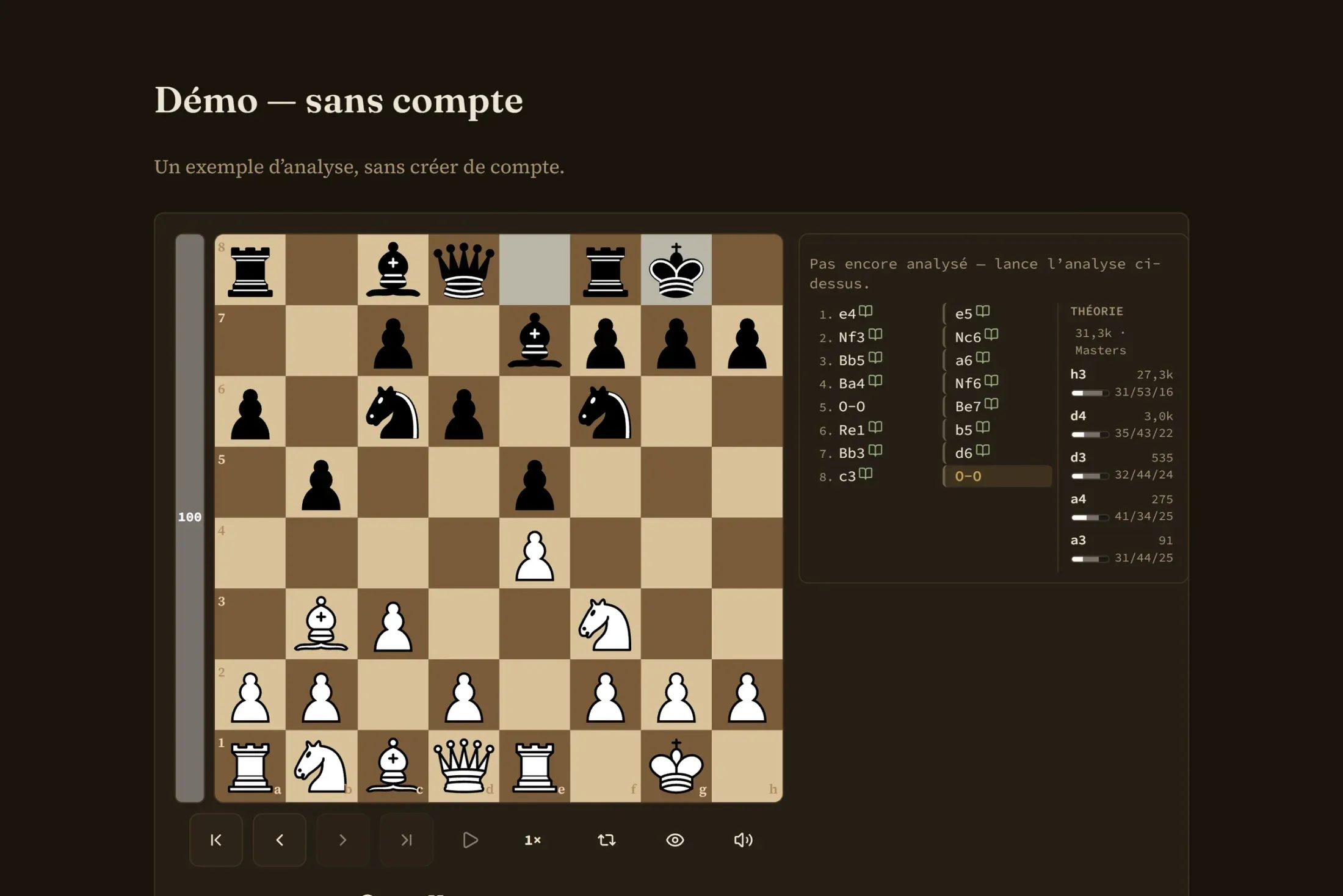
Each game is then analysed in the browser: Stockfish, compiled to WebAssembly, runs in workers, after the endgame tablebases and Lichess’s shared evaluation when they answer. Moves are graded by what they cost, from inaccuracy to blunder, and a summary written by rules, with no language model, says why the game was lost. Alongside, the viewer shows master-game theory, threats and lines of force.
The player’s profile is read across many games at once. The progress page looks for mistakes that come back: a weakness only counts if it appears in at least two distinct games, sorted by phase of the game, by opening or by lack of time, the latter read from the clock times stored in the PGN. Around it: the opening repertoire, results by time control and by phase, and the trend over time.
The psychological side is more modest, and is presented as such: a self-report questionnaire on four axes (tilt, focus, appetite for risk, recovery), a daily journal (sleep, caffeine, motivation) and a warning when losses pile up, from three in a row. These are simple rules applied to what the player reports, not a measurement.
Training starts from the player’s own mistakes: every serious error whose best move is known becomes a position to find again, brought back at intervals that grow with each success. On top of that: a starting diagnostic calibrated on puzzles from Lichess’s open database, sets to repeat until they are solved fast, master games whose moves must be guessed, and a puzzle of the day shared within a group.
The application also runs on Android, in a Capacitor shell that updates itself. The whole is covered by more than 1,800 automated tests.
An instructive defect: the login link sent by email broke as soon as it was opened anywhere other than the original browser, another device or the mail client’s preview, the code being consumed silently. The problem was not in the application’s code but in the chosen protocol; the flow was changed rather than patched.
The name comes from the Lucena position, the manoeuvre that wins the rook-and-pawn endgame, and from the oldest printed chess book, in 1497. Lucerna, in Latin, is the lamp.