Certo
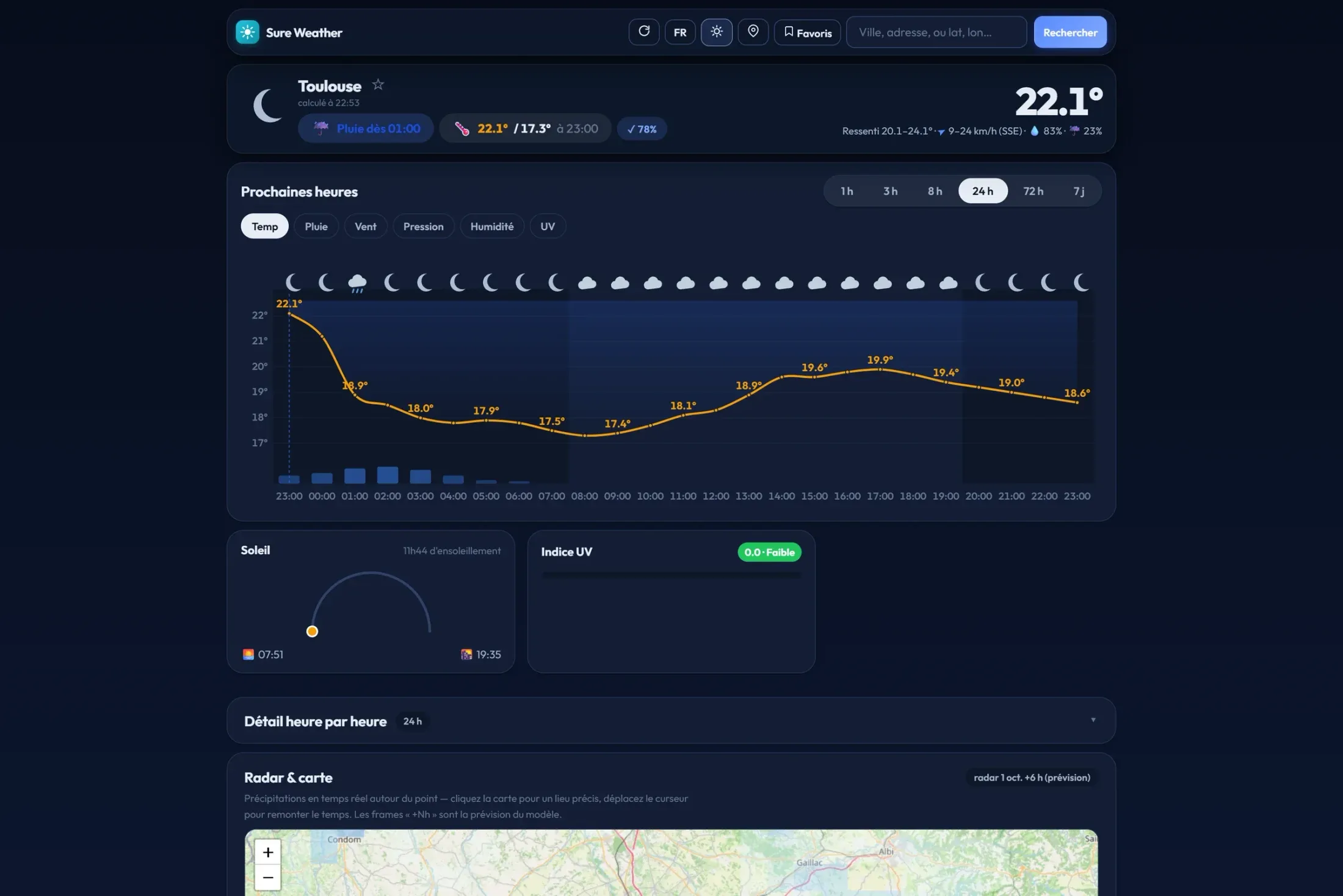
An Android weather app that cross-checks several forecast models, with a confidence index per source. The subject is not tomorrow's weather, it is how to weight sources that contradict each other.
The shortest of these projects, and the one whose statement travels best elsewhere. Several providers announce tomorrow’s weather, they disagree, and averaging the forecasts is a bad answer: it treats a provider that is often right and one that is often wrong as two equivalent opinions.
The sources are the major numerical models, GFS, ECMWF, ICON, MetNo, ARPEGE, taken without an API key. Confidence is not assigned to them once and for all: the world is cut into cells of about a tenth of a degree, each cell accumulates the history of gaps between what was announced and what happened, and providers are weighted by the inverse of the variance learned there, for that variable and that horizon. A model excellent on the Atlantic coast and mediocre in an alpine valley therefore does not carry the same weight in both places.
The answer to the question that matters is yes: the aggregate is checked against the weather actually observed, not against the other forecasts. Ground truth comes from historical reanalysis, and that is what closes the loop, collect, observe, calibrate, forecast. Without that step, a consensus is only a poll among models.
The project started as a Python repository, a collector and an API. It became Certo, an installable Android app, at version 1.5.3 in October 2026: a home-screen widget, and an update offered inside the app as soon as a new version is published. Behind it, the same FastAPI API serves the forecasts, the radar and the widget; it also serves an installable web version (PWA), for anyone without Android.
What is missing is the local side: personal weather stations, which measure the garden rather than the grid cell. That is where the per-source confidence index would have the most to say.
Download for Android · v1.5.3The code on GitHub
The file from the latest published release. On Android, installs from this source must be allowed.